what food to people eat on chinese new year?
Certain dishes are eaten during the Chinese New Year for their symbolic meaning. Lucky food is served during the 16-day festival flavour, particularly on Chinese New year dinner on New year's day's Eve, which is believed to bring skillful luck for the coming year.
The auspicious symbolism of these traditional Chinese New year foods is based on their pronunciations or appearance. Not simply do the dishes themselves matter, but also the training, and means of serving and eating mean a lot.
The about common Chinese New Year foods include dumplings, fish, jump rolls, and niangao.Nosotros've rounded upwardly 7 essential Chinese, or Lunar, New Yr dishes, and included the symbolism behind them all.

1. Fish — an Increase in Prosperity
Steam fish
In Chinese, "fish" (鱼 Yú /yoo/) sounds like 'surplus'. Fish is a traditional Chinese New Twelvemonth dish on the Chinese New year dinner carte du jour. Chinese people e'er similar to accept a surplus at the end of the year, because they think if they accept managed to relieve something at the end of the year, then they tin can brand more than in the next year.
Steamed fish is one of the almost famous Chinese New Year recipes.What fish should be chosen for the New Year dinner is based on auspicious homophonics.
- Crucian bother: As the first character of 'crucian bother' (鲫鱼 jìyú /jee-yoo/) sounds like the Chinese discussion 吉 (jí /jee/ 'practiced luck'), eating crucian bother is considered to bring practiced luck for the next twelvemonth.
- Chinese mud carp: The first part of the Chinese for "mud carp" (鲤鱼 lǐyú /lee-yoo/) is pronounced like the word for gifts (礼 lǐ /lee/). So Chinese people think eating mud carp during the Chinese New Year symbolizes wishing for good fortune.
- Catfish: The Chinese for "catfish" (鲶鱼 niányú /nyen-yoo/) sounds like 年余 (nián yú) significant 'year surplus'. So eating catfish is a wish for a surplus in the yr.
- Eating two fish, one on New year's Eve and one on New year, (if written in a certain way) sounds similar a wish for a surplus yr-after-twelvemonth.
- If only ane catfish is eaten, eating the upper role of the fish on New Year's Eve and the remainder on the starting time day of the new year's day can be spoken with the same homophonic significant.
How a Fish Is Eaten Matters a Lot
The fish should be the concluding dish left with some left over, as this has auspicious homophonics for there being surpluses every twelvemonth. This is practiced north of the Yangtze River, but in other areas the head and tail of the fish shouldn't be eaten until the beginning of the year, which expresses the promise that the twelvemonth volition start and end with surplus.
At that place are some rules related to the position of the fish.
- The head should exist placed toward distinguished guests or elders, representing respect.
- Diners tin savour the fish simply subsequently the one who faces the fish head eats first.
- The fish shouldn't be moved. The two people who confront the caput and tail of fish should drink together, as this is considered to have a lucky significant.
These customs are observed in a lively and light-hearted spirit, full of laughing and banter.
Fish tin can be cooked in various ways such as humid, steaming, and braising. The nigh famous Chinese fish dishes include steamed weever, West Lake fish with pickled cabbage and chili, steamed fish in vinegar sauce, and boiled fish with spicy broth.
Lucky Sayings for Eating Fish
- 年年有余 (Niánnián yǒu yú /nyen-nyen yo yoo/): May you always have more than yous need!
- 鱼跃龙门 (Yú yuè lóngmén /yoo ywair long-mnn/): Success in your test! ('A fish leaping over the dragon gate' implies successfully passing a competitive examination.)
2. Chinese Dumplings — Wealth
Dumplings
With a history of more than 1,800 years, dumpling (饺子 Jiǎozi /jyaoww-dzrr/) is a classic lucky food for Lunar New year, and a traditional dish eaten on Chinese New Year's Eve, widely popular in Prc, especially in North China.
Chinese dumplings tin can be made to await like Chinese argent ingots (which are non bars, merely boat-shaped, oval, and turned up at the two ends). Fable has it that the more than dumplings you consume during the New year's day celebrations, the more than coin y'all can make in the New Year.
Dumplings by and large consist of minced meat and finely-chopped vegetables wrapped in a thin and elastic dough pare. Popular fillings are minced pork, diced shrimp, fish, ground craven, beef, and vegetables. They can be cooked by boiling, steaming, frying or baking.
How they're made: Nearly all Chinese people tin make dumplings. Showtime they mix the dough, second make the dough into round "wrappers" with a rolling pin, 3rd make full the wrappers with stuffing, fourth compression the "wrapper" together into the desired shape, and fifth cook them.
Different Dumpling Fillings Take Different Meanings
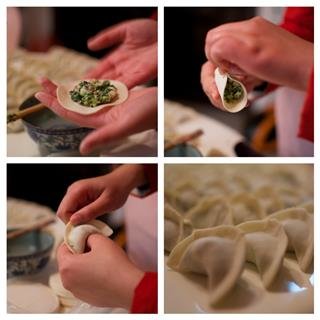
Chinese don't eat Chinese sauerkraut (酸菜 suāncài /swann-tseye/) dumplings at Spring Festival, because it implies a poor and hard hereafter. On New Year's Eve information technology is a tradition to swallow dumplings with cabbage and radish, implying that i'due south pare will become fair and one'southward mood will become gentle.
How to Brand LUCKY Dumplings
- When making dumplings in that location should exist a good number of pleats. If you make the junction besides apartment, it is thought to purport poverty.
- Some Chinese put a white thread inside a dumpling, and the i who eats that dumpling is supposed to possess longevity. Sometimes a copper coin is put in a dumpling, and the one who eats information technology is supposed to become wealthy.
- Dumplings should exist arranged in lines instead of circles, because circles of dumplings are supposed to mean one's life will go round in circles, never going anywhere.
Lucky Proverb for Eating Dumplings
Zhāo cái jìn bǎo (招财进宝/jaoww tseye jin baoww/): 'Bringing in wealth and treasure' — a felicitous wish for making coin and amassing a fortune.
Read more about Chinese dumplings.
3. Leap Rolls — Wealth
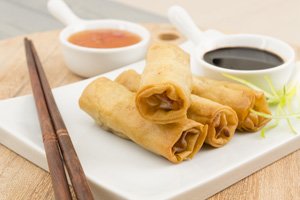 Spring rolls
Spring rolls (春卷 Chūnjuǎn /chwnn- jwen/) get their name considering they are traditionally eaten during the Spring Festival. It is a Chinese New Twelvemonth dish especially popular in East China: Jiangxi, Jiangsu, Shanghai, Fujian, Guangzhou, Shenzhen, Hong Kong, etc.
Spring rolls are a Cantonese dim sum dish of cylindrical-shaped rolls filled with vegetables, meat, or something sweetness. Fillings are wrapped in thin dough wrappers, then fried, when the spring rolls are given their golden-yellowish colour.
Lucky Saying for Eating Spring Rolls
黄金万两 (hwung-jin wan-lyang/): 'A ton of gilt' (because fried bound rolls await similar gold bars) — a wish for prosperity.
Read more nigh spring rolls.
4. Pasty Rice Cake — a Higher Income or Position
Chinese New Year cakes
Glutinous rice cake (年糕 Niángāo /nyen-gaoww/) is a lucky food eaten on Chinese New Year's Eve. In Chinese, mucilaginous rice cake sounds like it means "getting higher yr-on- by year". In Chinese people's minds, this means the higher you are the more prosperous your business is a general comeback in life. The principal ingredients of niangao are viscous rice, sugar, chestnuts, Chinese dates, and lotus leaves.
Lucky Maxim for Eating Niangao
年年高 (niánnián gāo /nyen-nyen gaoww/): 'Getting higher yr-afterwards-year by yr', tin imply children'south pinnacle, rise in business concern success, better grades in study, promotions at work, etc.
Read more details on Nian gao.
five. Sweetness Rice Balls — Family Togetherness
Sweet rice assurance
Sweet rice ball (汤圆 Tāngyuán /tung-ywen/) is the chief nutrient for China'south Lantern Festival, withal, in south China, people eat them throughout the Spring Festival. The pronunciation and round shape of tangyuan are associated with reunion and beingness together. That's why they are favored by the Chinese during the New Yr celebrations.
Lucky Sayings for Eating Tangyuan
团团圆圆 (Tuántuán yuányuán /twann-twann ywen-ywen/ 'group-group round-round'): Happy (family unit) reunion!
6. Longevity Noodles — Happiness and Longevity
Chinese Longevity Noodles
Longevity noodles (长寿面 Chángshòu Miàn /chung-show myen/) unsurprisingly symbolize a wish for longevity. Their length and unsevered preparation are also symbolic of the eater's life.
Information technology is a lucky food eaten on Chinese New Year Day in North China.
They are longer than normal noodles and uncut, either fried and served on a plate, or boiled and served in a basin with their broth.
7. Good Fortune Fruit — Fullness and Wealth
Certain fruits are eaten during the Chinese New year period, such as tangerines and oranges, and pomeloes. They are selected as they are particularly round and "golden" in color, symbolizing fullness and wealth, simply more plainly for the lucky audio they bring when spoken.
Chinese New year's day fruits
Eating and displaying tangerines and oranges is believed to bring adept luck and fortune due to their pronunciation, and fifty-fifty writing. The Chinese for orange (and tangerine) is 橙 (chéng /chnng/), which sounds the same as the Chinese for 'success' (成). One of the ways of writing tangerine (桔 jú /jyoo/) contains the Chinese graphic symbol for luck (吉 jí /jee/).
Eating pomeloes/shaddocks is thought to bring continuous prosperity. The more yous consume, the more wealth information technology will bring, as the traditional proverb goes. The Chinese for pomelo (柚 yòu /yo/) sounds like 'to have' (有 yǒu), except for the tone, and exactly like 'once again' (又 yòu).
Keep to read Chinese New year 2022
howarddentrecheigh75.blogspot.com
Source: https://www.chinahighlights.com/travelguide/chinese-food/chinese-new-year-food.htm

Post a Comment for "what food to people eat on chinese new year?"